Author: Shane Graham
In the fast-paced and highly competitive landscape of Australian business, hitting a growth plateau is a common and frustrating reality for many small to medium enterprises (SMEs). You have a great product, a dedicated team, and a steady customer base, but scaling to the next tier of revenue requires something more: strategic marketing leadership.
For many founders and CEOs, the default solution is to hire a traditional, full-time Chief Marketing Officer. However, a newer, more flexible model has emerged. Consider this article your definitive, practical comparison guide for Australian SMEs choosing between a virtual CMO and a full-time CMO.
Whether you are looking to refine your strategy, restructure your team, or drive measurable revenue, understanding the dynamic of a virtual CMO vs full-time CMO is critical. Let’s explore what each role entails, how much they cost, and how to determine the best fit for your company’s current stage of growth.
Before making a decision, it is essential to define the terminology. A full-time CMO is an in-house executive who sits on your C-suite, works 40+ hours a week exclusively for your brand, and oversees all marketing operations, team management, and long-term brand strategy.
Conversely, a virtual CMO (often used interchangeably with a fractional CMO) is a highly experienced marketing executive who works with your business on a part-time or retainer basis. When you engage a fractional CMO Australia-wide, you are essentially renting C-level expertise for a fraction of the time and cost.
Often operating under the model of CMO as a service Australia, these professionals provide high-level strategy, oversee the execution team, and align marketing with sales goals without being on your full-time payroll. A virtual chief marketing officer gives you the intellectual capital of an industry veteran, precisely when you need it most.
Many businesses struggle to identify exactly when they need senior marketing oversight. Here are the most common signs your SME needs a chief marketing officer:
At this stage, many founders ask: “Can’t I just hire a Head of Marketing?”
It is crucial to understand the difference between head of marketing and cmo. A Head of Marketing or Marketing Manager is typically tactical. They are brilliant at executing campaigns, managing social calendars, and coordinating with designers. A CMO, on the other hand, is strategic. They analyze market share, dictate pricing strategies, manage the P&L of the marketing department, and ensure marketing acts as a revenue driver rather than a cost centre.
If your execution is failing, you might need a manager. If your strategy is missing entirely, you need a CMO.

Budget is often the deciding factor for growing businesses. Let’s look at a realistic fractional cmo vs full-time cmo cost comparison.
Executive marketing salaries in Australia have surged in recent years. A highly qualified, full-time CMO will typically demand a base salary ranging from $220,000 to $350,000+ per year. Once you factor in superannuation, bonuses, equity, and recruitment fees, the true cost of a full-time hire can easily exceed $300,000 to $400,000 annually.
In contrast, hiring a part-time CMO or leveraging outsourced CMO Australia services typically costs between $3,000 and $10,000 per month, depending on the scope of work (e.g., 1 to 3 days a week). This structure allows SMEs to access top-tier talent for roughly $36,000 to $120,000 a year.
When calculating the ROI of hiring a fractional marketing leader, the numbers speak for themselves. You save hundreds of thousands of dollars on overhead, which can be redirected into your actual marketing budget—funding better campaigns, software, or junior team members to execute the strategy.
Pros:
Cons:
Pros:
Cons:
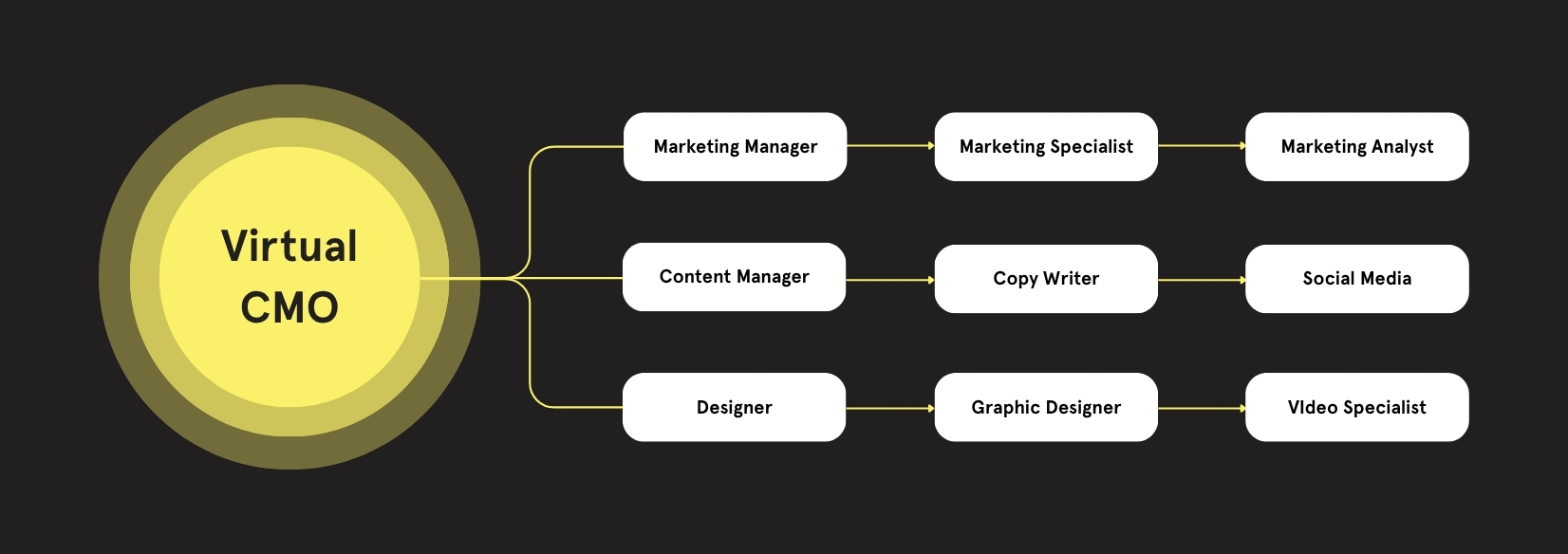
When implementing marketing leadership outsourcing, you must build an ecosystem that supports them. Scaling marketing operations for SMEs doesn’t mean hiring an army; it means hiring smart.
An optimal marketing department structure for small business utilizing a virtual CMO looks like this:
This modular setup is particularly effective as fractional marketing leadership for b2b startups, where agility and lean operations are paramount for survival and funding rounds.
If you have decided that a virtual CMO Australia is the right path, finding the right talent requires diligence. While standard executive recruitment for Australian SMEs focuses on full-time placements, hiring a fractional leader requires a slightly different approach.
Here are actionable steps on how to hire a part-time marketing executive:
A virtual CMO is an incredible catalyst for growth, but it is rarely a forever solution for rapidly expanding companies. So, when to transition from a virtual to full-time cmo?
Look for these milestones:
A great fractional CMO will actually tell you when it is time to replace them. They will help you write the job description, interview candidates, and ensure a smooth handover, ensuring your marketing leadership for Australian small businesses remains uninterrupted.
Choosing between a full-time executive and a virtual alternative is one of the most significant operational decisions an SME founder will make.
If your business is generating consistent revenue but lacks the strategic direction to scale further, you don’t necessarily need to take on the massive financial burden of a $300,000 salary. Leveraging a virtual CMO offers a powerful, low-risk, high-reward alternative. It allows you to inject top-tier senior marketing expertise into your business, optimize your current team structure, and build a scalable foundation for the future.
Take a hard look at your current growth trajectory, evaluate your budget, and consider how the strategic insights of a fractional leader could transform your business from a steady player into an industry powerhouse.
Ready to explore what fractional marketing leadership could look like for your business? Talk to the Gild Grow team today.